
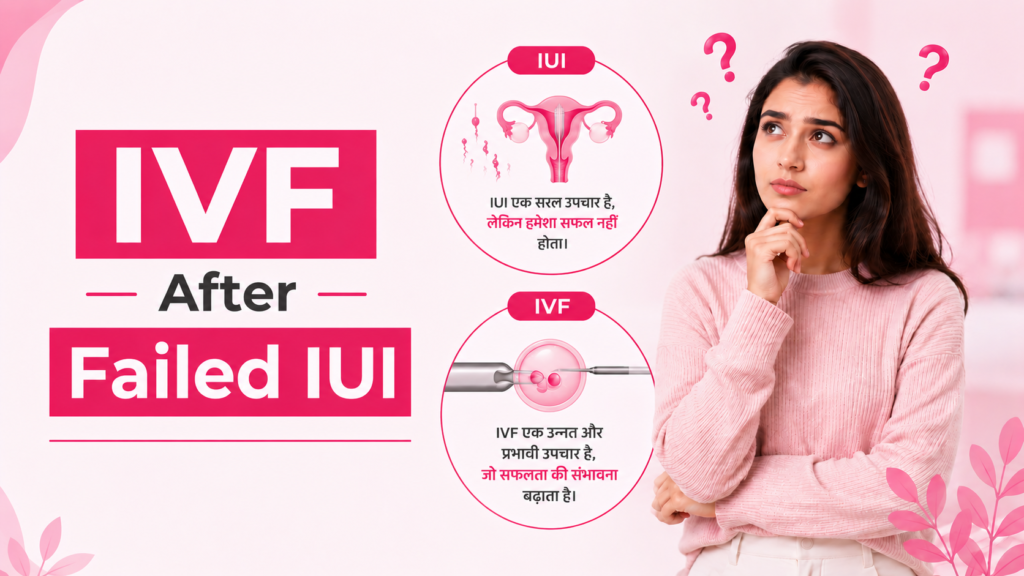
IVF After Failed IUI
When an intrauterine insemination (IUI) cycle does not result in pregnancy, it can be difficult to know what comes next. A failed IUI does not necessarily mean that IVF is the only option, but for many people—particularly after several well-timed IUI cycles—IVF becomes the next evidence-based treatment to discuss.
The important point is that moving from IUI to IVF is not simply “doing the same thing with stronger medication.” IVF changes where fertilization occurs, gives the fertility team more information about egg and sperm performance, and allows embryos to be selected for transfer.
For unexplained infertility, the American Society for Reproductive Medicine (ASRM) generally recommends a limited course of ovarian stimulation with IUI before moving to IVF. Its guideline specifically describes three or four cycles of stimulated IUI with oral medications, followed by IVF when those treatments are unsuccessful.
What Does a Failed IUI Mean?
IUI places prepared sperm directly into the uterus around the time of ovulation. Fertilization must still occur naturally inside the fallopian tube.
Therefore, an unsuccessful IUI does not tell you that fertilization cannot happen. A single unsuccessful cycle may simply reflect the relatively low probability of conception in any individual treatment cycle.
Several factors influence the outcome, including:
- Age and ovarian reserve
- Number and quality of developing follicles
- Ovulation timing
- Sperm count and motility
- Fallopian-tube health
- Endometriosis
- Duration and cause of infertility
- Embryo-forming potential of the eggs and sperm
If several properly performed IUI cycles have failed, however, your fertility specialist may reassess the diagnosis and treatment strategy rather than simply repeating the same protocol.
When Is IVF Considered After IUI?
There is no universal rule that says IVF must begin after exactly one, two, three, or four failed IUIs.
The decision depends on why IUI was being used in the first place and factors such as age, ovarian reserve, sperm parameters, tubal status and previous treatment response.
For unexplained infertility, ASRM recommends moving to IVF after unsuccessful stimulated IUI with oral medications rather than routinely escalating to gonadotropin-stimulated IUI.
Age can also affect how quickly treatment should escalate. ASRM notes evidence that immediate IVF may provide a higher pregnancy rate and shorter time to pregnancy for some women aged 38 and older compared with continuing IUI-based treatment.
In other words, the number of failed IUIs is only one part of the decision.
What Changes With IVF?
The biggest difference is where fertilization occurs.
With IUI
The process is generally:
Ovulation → IUI → fertilization inside the body → embryo develops → implantation
With IVF
The process becomes:
Ovarian stimulation → egg retrieval → fertilization in the laboratory → embryo development → embryo transfer
This gives the fertility team considerably more control over the reproductive process.
During IVF, doctors can see:
- How many eggs were retrieved
- How many eggs were mature
- Whether fertilization occurred
- How embryos developed
- How many embryos are suitable for transfer or freezing
That additional information can be valuable when deciding what to do next.
What Happens Before Starting IVF?
Before beginning an IVF cycle, your fertility specialist will typically review your previous IUI cycles and confirm whether additional evaluation is needed.
The exact work-up varies according to your history, but may include assessment of:
Ovarian reserve
Tests such as AMH and antral follicle count may help estimate expected ovarian response. These tests are useful for treatment planning, but they do not independently determine whether pregnancy is possible.
Ovulation
Your physician may review whether you ovulated consistently and how you responded to stimulation medications.
Tubal factors
If there is concern about blocked or damaged fallopian tubes, appropriate imaging or evaluation may be considered.
Semen parameters
The male partner’s semen analysis remains important. A failed IUI can sometimes prompt a closer review of sperm concentration, motility and morphology.
Uterine factors
Depending on symptoms and previous investigations, your physician may evaluate the uterine cavity for issues such as polyps, fibroids or adhesions.
The objective is not to order every possible fertility test. Instead, testing should be guided by your medical and reproductive history.
ASRM emphasizes tailoring infertility treatment to the suspected cause and considering referral to a reproductive endocrinologist when initial treatments are unsuccessful or advanced reproductive technologies are being considered.
How IVF Treatment Is Different From IUI
The treatment is more involved because several additional stages occur.
1. Ovarian stimulation
Instead of allowing one follicle to develop naturally, injectable fertility medications are generally used to stimulate the ovaries to develop multiple follicles.
Ultrasound scans and hormone monitoring help the fertility team determine how the ovaries are responding.
The goal is not simply to produce as many eggs as possible. The protocol is individualized according to factors such as age, ovarian reserve and previous response to treatment.
2. Trigger injection
When the follicles reach an appropriate stage of development, a trigger medication is administered to help complete final egg maturation.
The timing is carefully planned because egg retrieval generally occurs approximately 34–36 hours afterward, depending on the protocol.
3. Egg retrieval
Egg retrieval is performed using ultrasound guidance, usually through the vagina.
The retrieved eggs are then examined in the embryology laboratory to determine how many are mature.
4. Fertilization
This is one of the most important differences from IUI.
With IVF, eggs and sperm are brought together in the laboratory.
Fertilization may be performed using conventional IVF or, when indicated, intracytoplasmic sperm injection (ICSI), in which an individual sperm is injected directly into an egg.
ICSI is not automatically necessary after a failed IUI.
Current ASRM guidance states that routine ICSI is not recommended for people without male-factor infertility simply because IVF is being performed. It may have a role in selected circumstances, including previous poor or absent fertilization with conventional IVF.
5. Embryo development
Fertilized eggs are monitored as they develop into embryos.
The embryology team can assess embryo development before a transfer or freezing decision is made.
6. Embryo transfer
An embryo can subsequently be transferred into the uterus.
Depending on the circumstances, the transfer may occur in the same treatment cycle or after embryos have been frozen for a later frozen embryo transfer.
Why IVF Can Be More Informative After Failed IUI
One major advantage of IVF is that it provides information that IUI cannot.
With IUI, there is no direct opportunity to observe:
- Whether the egg fertilized
- How many eggs actually fertilized
- How embryos developed
- Whether embryo development stopped at an early stage
IVF allows the embryology laboratory to observe these stages.
For example, suppose several follicles developed during IUI but pregnancy did not occur. IVF may reveal that a reasonable number of eggs can be retrieved and fertilized, or it may identify an unexpectedly low fertilization or embryo-development rate.
That information can help guide subsequent treatment.
Does Failed IUI Mean IVF Will Fail Too?
No.
A failed IUI does not automatically predict IVF failure.
IUI and IVF overcome different parts of the reproductive process.
With IUI, sperm are placed closer to the egg, but fertilization and early embryo development still occur inside the reproductive tract.
With IVF, fertilization and early embryo development occur under laboratory observation before an embryo is transferred.
That difference is one reason IVF may be recommended after repeated unsuccessful IUI cycles.
However, IVF is not a guarantee of pregnancy. Success depends heavily on factors such as age, ovarian response, egg and sperm factors, embryo development and the underlying cause of infertility.
Should You Try Another IUI or Move to IVF?
This is one of the most important decisions after an unsuccessful cycle.
A discussion with your fertility specialist should consider:
Your age
Because reproductive potential changes with age, spending additional months repeating treatments may have different implications at different ages.
How many IUIs you’ve already completed
One failed IUI is very different from several unsuccessful, well-monitored cycles.
How the IUI cycle performed
Your doctor may review:
- Number of mature follicles
- Endometrial lining
- Ovulation timing
- Trigger timing
- Post-wash sperm count and motility
- Medication used
- Any complications
The underlying diagnosis
The best next step for unexplained infertility may differ from the approach for significant male-factor infertility, tubal disease, endometriosis or ovulatory disorders.
Ovarian reserve
If ovarian reserve is reduced, your specialist may recommend avoiding unnecessary delays.
Your priorities
Cost, treatment burden, time to pregnancy, emotional readiness and preferences all matter.
There is no single treatment pathway that is appropriate for every patient.
What If Only One IUI Failed?
If you have had just one unsuccessful IUI, IVF may not necessarily be the immediate next step.
Depending on your circumstances, your doctor may recommend another IUI cycle, modify medication or timing, or move toward IVF.
For unexplained infertility, ASRM’s evidence-based guideline describes a typical initial course of three or four stimulated IUI cycles using oral medications before IVF.
But “typical” does not mean mandatory.
For example, someone who is older or has a significant fertility factor may reasonably have a different treatment strategy from someone younger with unexplained infertility and a good ovarian reserve.
What If Several IUIs Have Failed?
After multiple unsuccessful IUIs, simply repeating the same treatment may offer diminishing value.
At this point, your fertility specialist may discuss IVF more seriously because it can:
- Increase control over fertilization.
- Allow retrieval of multiple eggs.
- Provide information about fertilization.
- Allow observation of embryo development.
- Permit embryo freezing.
- Potentially allow genetic testing in selected situations.
- Offer the option of transferring a single embryo.
For many patients, the transition to IVF is therefore not merely an escalation in medication—it is a change in reproductive strategy.
Is ICSI Always Used During IVF After Failed IUI?
No.
This is a common misconception.
A failed IUI does not necessarily indicate that sperm cannot fertilize an egg. IUI failure can happen for many reasons unrelated to fertilization.
Current ASRM guidance recommends against routine ICSI for non-male-factor infertility. The procedure may be useful in selected situations, particularly when there has previously been poor or absent fertilization with conventional IVF.
Your clinic should explain why ICSI is or isn’t recommended in your specific case.
Can IVF Diagnose Why IUI Failed?
IVF can provide additional information, but it cannot always identify a single reason for infertility.
For example, IVF may show:
- A lower-than-expected number of mature eggs
- Unexpectedly poor fertilization
- Arrested embryo development
- A good number of developing embryos
This information can be clinically useful.
But even when eggs fertilize and embryos develop normally, implantation and pregnancy are still biological processes that cannot be completely predicted.
What Are the Risks of Moving to IVF?
IVF is generally safe when performed under appropriate medical supervision, but it is more invasive than IUI.
Potential risks include:
- Ovarian hyperstimulation syndrome (OHSS)
- Bleeding or infection related to egg retrieval
- Medication side effects
- Multiple pregnancy if more than one embryo is transferred
- Emotional and financial burden
- Rare complications associated with procedures or anesthesia
Modern IVF protocols can reduce certain risks. For example, elective single-embryo transfer can substantially reduce the risk associated with multiple gestation compared with transferring multiple embryos.
What Should You Ask Your Fertility Specialist After a Failed IUI?
Going into your follow-up appointment with specific questions can make the consultation more useful.
Consider asking:
- Why do you think this IUI did not work?
- How many follicles developed?
- Was ovulation timing optimal?
- What was the post-wash sperm count and motility?
- Do you recommend another IUI or IVF, and why?
- How does my age affect the recommendation?
- What does my ovarian reserve suggest about IVF response?
- Would you change the medication or protocol?
- Is ICSI recommended in my case?
- Would you recommend fresh or frozen embryo transfer?
- Is additional testing actually necessary before IVF?
- What is the estimated cumulative chance of success?
- What would you recommend if the first IVF cycle does not work?
These questions can help you understand the reasoning behind the proposed treatment rather than focusing only on the headline success rate.
IVF After Failed IUI: A Simple Decision Framework
You can think about the decision this way:
Failed IUI → Review the cycle → Reassess diagnosis and prognosis → Decide whether another IUI has meaningful value → Consider IVF when appropriate
Another IUI may be reasonable when:
- Only one or a small number of cycles have been attempted
- Prognosis remains favorable
- The underlying condition is appropriate for IUI
- There was a potentially correctable issue with the previous cycle
- The patient prefers another less-invasive attempt
IVF may be more appropriate when:
- Several appropriately performed IUIs have failed
- Age makes delaying treatment less desirable
- There is significant male-factor infertility
- Tubal factors make IUI ineffective
- Other fertility factors reduce the expected benefit of continued IUI
- The patient wants the additional information and treatment control IVF provides
The right choice should be individualized rather than based solely on the number of unsuccessful cycles.
Emotional Considerations After Failed IUI
A failed fertility treatment can be emotionally exhausting, particularly when you have invested time, money and hope into each cycle.
It is also important to remember that an unsuccessful IUI does not mean you did something wrong.
Fertility treatment involves probabilities rather than guarantees. Even when ovulation, sperm preparation, timing and ultrasound findings look favorable, pregnancy may not occur.
Moving to IVF can feel like a major milestone. Some people feel hopeful about having more control, while others feel overwhelmed by the injections, procedures and cost.
Both reactions are understandable.
If treatment is becoming emotionally difficult, discuss support options with your fertility clinic. Psychological counseling and fertility-support resources can be valuable alongside medical treatment.
Final Takeaway
A failed IUI is not necessarily a sign that pregnancy is unlikely. It is better viewed as information that helps determine whether continuing IUI or changing treatment makes the most sense.
For many patients with unexplained infertility, a limited course of stimulated IUI followed by IVF is an evidence-supported treatment pathway.
The transition to IVF changes the process significantly: eggs are retrieved, fertilization occurs in the laboratory, embryos can be observed as they develop, and an embryo can subsequently be transferred to the uterus.
The most appropriate next step depends on your age, diagnosis, ovarian reserve, sperm parameters, previous IUI response and personal treatment goals. A fertility specialist can use those factors to determine whether another IUI has meaningful value or whether IVF is the more efficient next step.
Medical information in this article is educational and should not replace individualized advice from a qualified fertility specialist.
Visit Vrinda Fertility
Take the next step toward your parenthood journey with expert fertility care, advanced treatments, and personalized treatment plans.
At Vrinda Fertility, experienced fertility specialists provide comprehensive care tailored to your individual fertility needs. Whether you are exploring IVF, IUI, ICSI, fertility preservation, or other advanced fertility treatments, our team is here to guide you at every step.
Visit Vrinda Fertility today to consult experienced fertility specialists, understand your treatment options, and choose the right path toward parenthood.
Book Your Consultation Today
Take the first step toward your dream of becoming a parent with Vrinda Fertility.