
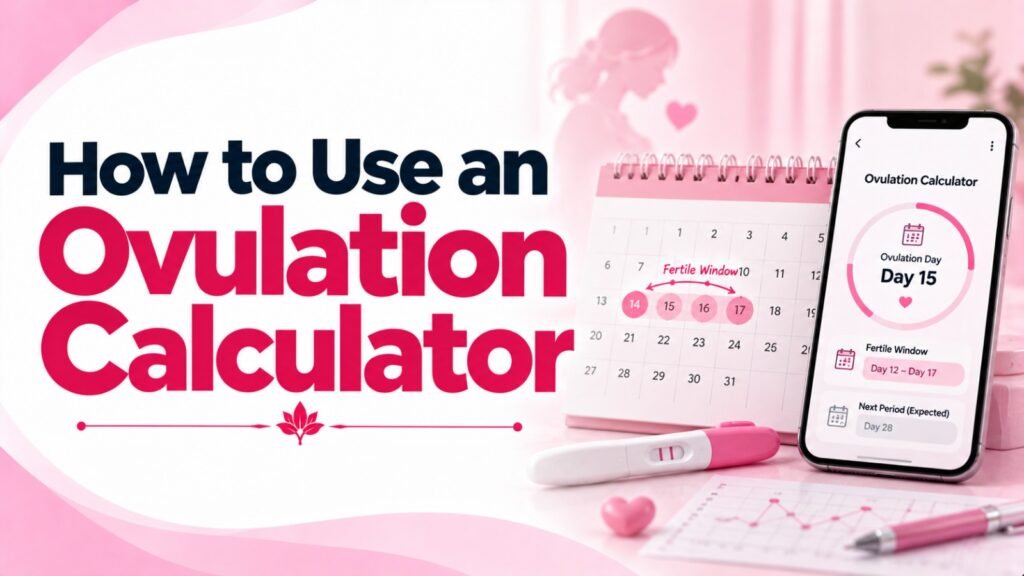
Ovulation Calculator
Trying to understand when ovulation happens can make the menstrual cycle feel much less confusing. Whether you are trying to conceive, tracking your cycle, or simply learning more about your reproductive health, an ovulation calculator can provide a useful estimate of your fertile days.
However, an ovulation calculator is not a crystal ball. It works by using information about your menstrual cycle to estimate when ovulation is likely to occur. Since ovulation can vary from one cycle to another, the estimate is most useful when combined with other fertility signs.
In this guide, we explain how to use an ovulation calculator, what information you need, how the fertile window is estimated, and what you can do if your cycles are irregular.
What Is an Ovulation Calculator?
An ovulation calculator is a tool that estimates when you may ovulate based on information about your menstrual cycle.
The calculation generally uses two main pieces of information:
- The first day of your last menstrual period
- Your typical menstrual cycle length
Based on these details, the tool estimates your next period and likely ovulation date. It may also provide an estimated fertile window, which is the period during which pregnancy is most likely if you have unprotected sex.
A typical menstrual cycle involves several hormonal and reproductive changes. Ovulation occurs when an ovary releases an egg. Because sperm can survive for several days in the female reproductive tract and the egg remains viable for a relatively short period after ovulation, pregnancy is possible from intercourse occurring in the days leading up to ovulation as well as around ovulation itself.
This is why simply identifying one “ovulation day” isn’t enough. The broader fertile window matters.
How Does an Ovulation Calculator Work?
Most ovulation calculator tools use a calendar-based method.
As a general estimate, ovulation occurs around 14 days before the next menstrual period, rather than necessarily occurring on day 14 of every cycle.
For example, suppose your menstrual cycle is usually 28 days long. If your period starts on day 1, ovulation may be estimated around day 14.
If your cycle is 32 days, ovulation may occur closer to day 18.
The important point is that the calculation is based on your expected next period and your usual cycle length.
A Simple Example
Imagine:
- First day of your last period: January 1
- Average cycle length: 28 days
An ovulation calculator may estimate ovulation around January 14.
Your fertile window could extend across several days around that estimated ovulation date.
If your cycle is 32 days instead, the estimated ovulation date would generally be later.
These are estimates rather than guarantees because the timing of ovulation can change.
How to Use an Ovulation Calculator
Using an ovulation calculator is usually straightforward. Follow these steps.
1. Record the First Day of Your Last Period
Start by identifying the first day of your most recent menstrual period.
This is cycle day 1.
Do not count the final day of bleeding as day 1. The cycle begins on the first day of actual menstrual bleeding.
Keeping a menstrual calendar or cycle-tracking app can make this easier.
2. Determine Your Average Cycle Length
Next, identify how long your menstrual cycles typically last.
Your cycle length is counted from:
The first day of one period → the day before the next period begins
For example, if your period begins on March 1 and your next period begins on March 29, that cycle is approximately 28 days.
If your cycles vary, don’t simply choose an unusually short or long cycle. Looking at several previous cycles can give you a better idea of your typical pattern.
3. Enter Your Information
Enter your last menstrual period date and average cycle length into the ovulation calculator.
Some calculators may ask for additional information, such as:
- Average cycle length
- Period duration
- Previous cycle dates
- Whether your cycles are regular
The tool then uses the information to estimate your ovulation date and fertile window.
4. Look at the Fertile Window
Don’t focus only on the predicted ovulation date.
The more useful result is often the fertile window, which includes the days when conception is most likely.
Because sperm can survive for several days under favorable conditions, intercourse before ovulation can result in pregnancy.
For people trying to conceive, having sex regularly during the estimated fertile window may be more useful than trying to identify one exact day.
5. Compare the Estimate With Your Cycle Signs
An ovulation calculator becomes more informative when you compare its prediction with physical signs of ovulation.
These may include:
- Changes in cervical mucus
- A rise in basal body temperature after ovulation
- A positive ovulation predictor test
- Changes in some people’s libido or other cycle-related symptoms
Using multiple indicators can give you a better understanding of your individual cycle than relying exclusively on a calendar calculation.
How Accurate Is an Ovulation Calculator?
An ovulation calculator can be helpful for estimating fertile days, but it cannot determine your exact ovulation date with certainty.
That’s because menstrual cycles are not always perfectly predictable.
Stress, illness, travel, changes in sleep, weight changes, hormonal fluctuations, breastfeeding, and other factors can affect cycle timing.
Even people who usually have regular periods can occasionally ovulate earlier or later than expected.
This is why calendar-based ovulation prediction should be treated as an estimate, not a confirmation of ovulation.
If avoiding pregnancy is your goal, relying solely on an ovulation calculator is particularly important to reconsider because predicting ovulation from dates alone may not provide reliable contraception.
Ovulation Calculator vs. Ovulation Test
An ovulation calculator and an ovulation test serve different purposes.
An ovulation calculator estimates when ovulation is likely based primarily on your cycle history.
An ovulation predictor kit, on the other hand, detects a rise in luteinizing hormone (LH) in urine. The LH surge generally occurs shortly before ovulation.
Here’s a simple comparison:
| Method | What it does |
|---|---|
| Ovulation calculator | Estimates fertile days from cycle information |
| Ovulation predictor kit | Detects an LH surge |
| Basal body temperature | Helps identify a temperature rise after ovulation |
| Cervical mucus tracking | Looks for mucus changes associated with the fertile period |
For someone trying to conceive, these methods can potentially complement each other.
What Is the Best Time to Use an Ovulation Calculator?
You can use an ovulation calculator at any point in your cycle, but entering your information after each period can help you keep your predictions updated.
For people trying to conceive, the prediction can help identify when to start paying closer attention to fertility signs.
For example, if your cycles are typically around 28 days, you may know approximately when your fertile period is approaching. You can then combine the calendar estimate with cervical mucus observations or ovulation tests.
The key is consistency. Recording your periods over several months can provide a clearer picture than relying on one cycle.
How Cycle Length Changes the Prediction
One of the most important things to understand about an ovulation calculator is that cycle length matters.
Consider three hypothetical cycle lengths:
- 26-day cycle: ovulation may occur relatively early
- 28-day cycle: ovulation may occur around the middle of the cycle
- 32-day cycle: ovulation may occur later
This demonstrates why the popular idea that everyone ovulates on day 14 is misleading.
Day 14 is a useful reference point for a classic 28-day cycle, but it does not represent every person’s biology.
The calculation is also more difficult when cycle length changes significantly from month to month.
Can You Use an Ovulation Calculator With Irregular Periods?
You can use an ovulation calculator with irregular cycles, but the results may be less reliable.
For example, suppose your cycles range from 25 to 35 days. A calculator based on one average cycle length may not accurately predict the timing of ovulation in every month.
If your cycles are irregular, consider tracking:
- The start date of every period
- Cycle length
- Cervical mucus changes
- Basal body temperature
- Ovulation predictor tests
- Other recurring cycle patterns
A healthcare professional can also help evaluate persistently irregular periods, especially if you are trying to conceive.
Irregular cycles can sometimes be associated with conditions that affect ovulation, so they should not automatically be dismissed as simply “normal variation.”
How to Calculate Ovulation Without a Calculator
You can also estimate ovulation manually.
A commonly used calendar-based approach is:
Expected next period − approximately 14 days = estimated ovulation
For example, if you expect your next period in 30 days, ovulation might be estimated approximately 14 days before it.
But remember that the 14-day figure is an approximation. The length of the phase before ovulation can vary considerably, while the time between ovulation and the next period is often more consistent for an individual.
This is one reason an ovulation calculator can be convenient: it performs the date calculation for you and presents the likely fertile window in an easier format.
How to Identify Signs of Ovulation
An ovulation calculator provides a calendar estimate, but your body may provide additional clues.
Cervical Mucus
Around the fertile period, cervical mucus may become clearer, wetter, more slippery, and more stretchy.
This type of mucus can help sperm move through the reproductive tract.
After ovulation, cervical mucus commonly becomes thicker or less abundant.
Basal Body Temperature
Basal body temperature is your body’s resting temperature measured under consistent conditions, usually immediately after waking.
After ovulation, hormonal changes can cause a small sustained increase in basal body temperature.
Because the temperature rise typically occurs after ovulation, BBT is more useful for confirming a pattern retrospectively than predicting the exact moment ovulation will occur.
Ovulation Predictor Kits
Ovulation predictor kits detect LH in urine.
A positive result indicates an LH surge and suggests that ovulation may be approaching.
Using an ovulation predictor kit alongside an ovulation calculator can therefore provide more information than using the calendar estimate alone.
Can an Ovulation Calculator Tell You When You Will Get Pregnant?
No.
An ovulation calculator can estimate when you are likely to be fertile, but it cannot predict whether or when pregnancy will occur.
Pregnancy depends on many factors, including:
- Whether ovulation occurs
- Timing and frequency of intercourse
- Sperm health
- Egg quality
- Fallopian tube function
- Uterine and cervical factors
- Age
- Overall reproductive health
Even when intercourse occurs during the fertile window, pregnancy is not guaranteed.
The purpose of an ovulation calculator is to help with timing—not to diagnose fertility or guarantee conception.
Using an Ovulation Calculator When Trying to Conceive
If you are trying to become pregnant, an ovulation calculator can be a convenient starting point for understanding your cycle.
Instead of becoming overly focused on one predicted day, consider the fertile window as a period of opportunity.
Having intercourse regularly throughout the fertile period can reduce the pressure associated with trying to identify one “perfect” day.
You can also combine calendar tracking with other fertility-awareness methods.
If pregnancy has not occurred after a period of regular attempts, discussing your situation with a fertility specialist may be appropriate. The appropriate time to seek an evaluation can vary depending on age, medical history, cycle regularity, and other circumstances.
Common Mistakes When Using an Ovulation Calculator
Even a good ovulation calculator can become less useful if the information entered into it is inaccurate.
Mistake 1: Assuming Everyone Ovulates on Day 14
Day 14 is not a universal ovulation day.
Cycle length and individual variation matter.
Mistake 2: Entering the Wrong Period Date
The first day of menstrual bleeding should generally be recorded as cycle day 1.
An incorrect starting date can shift the entire prediction.
Mistake 3: Ignoring Cycle Variation
If your cycles vary substantially, using one fixed cycle length may produce misleading estimates.
Mistake 4: Treating the Prediction as Confirmation
A predicted date does not prove that ovulation actually occurred.
Use other fertility signs when greater accuracy is important.
Mistake 5: Using Calendar Prediction Alone for Birth Control
Calendar-based predictions can be wrong because ovulation can shift.
If you want to avoid pregnancy, discuss reliable contraceptive options with a qualified healthcare professional.
When Should You Speak to a Fertility Specialist?
An ovulation calculator is useful for cycle education, but it cannot replace professional evaluation.
Consider talking with a healthcare provider if you have:
- Very irregular or absent periods
- Repeatedly unpredictable cycles
- Significant pelvic pain
- Symptoms that concern you
- Difficulty conceiving
- A known reproductive or hormonal condition
- Concerns about ovulation
A fertility specialist can use medical history, ultrasound, hormone testing, and other appropriate assessments to determine whether ovulation is occurring and identify potential fertility concerns.
The Bottom Line
An ovulation calculator is a simple way to estimate when ovulation and your fertile window may occur. To use one, enter the first day of your last menstrual period and your typical cycle length, then review the predicted fertile days.
The most important thing to remember is that the result is an estimate. Ovulation does not necessarily happen on the same cycle day every month, even when periods appear regular.
For people trying to conceive, combining an ovulation calculator with fertility signs such as cervical mucus changes, basal body temperature tracking, or ovulation predictor kits can provide a more complete picture of the cycle.
And if your cycles are consistently irregular or conception is taking longer than expected, professional fertility guidance can help you understand what may be happening and what options are available.
Visit Vrinda Fertility
Take the next step toward your parenthood journey with expert fertility care, advanced treatments, and personalized treatment plans.
Visit Vrinda Fertility today and consult experienced fertility specialists to understand your fertility needs and explore the right treatment options for you.