
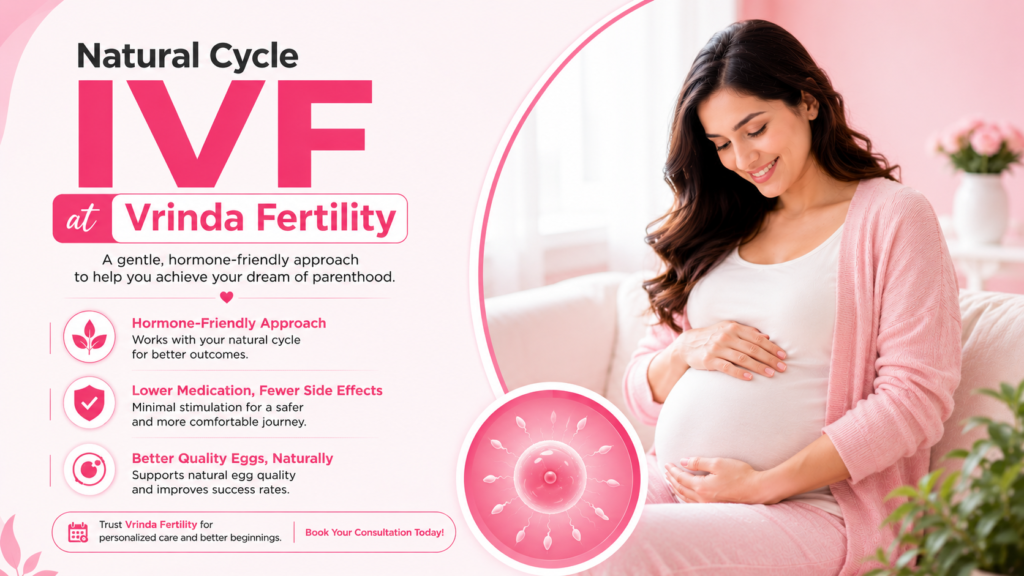
Mini IVF (Natural Cycle IVF):
For people exploring fertility treatment, conventional IVF is not the only option. Mini IVF, sometimes called Minimal Stimulation IVF, and Natural Cycle IVF use approaches designed to reduce or avoid the higher doses of ovarian-stimulating medication used in conventional IVF.
But a gentler medication protocol does not automatically mean a better treatment. The right approach depends on factors such as ovarian reserve, age, previous IVF outcomes, sperm quality, treatment goals, and how your body responds to stimulation.
So, is Mini IVF or Natural Cycle IVF right for you? The answer requires looking beyond medication dosage and considering the number and quality of eggs and embryos that can realistically be obtained.
What Is Mini IVF?
Mini IVF is an assisted reproductive treatment that uses lower doses of ovarian-stimulating medications than a typical IVF cycle.
The goal is usually to obtain a smaller number of eggs while reducing medication exposure, monitoring burden, and potentially treatment costs. Depending on the clinic and protocol, Mini IVF may involve oral medications, low-dose injectable hormones, or a combination of approaches.
Unlike Natural Cycle IVF, Mini IVF generally involves some ovarian stimulation.
The basic process may include:
- Initial fertility assessment and ovarian-reserve testing.
- Mild ovarian stimulation.
- Ultrasound and hormone monitoring.
- Medication to help control the timing of ovulation.
- Trigger medication when appropriate.
- Egg retrieval.
- Fertilization in the laboratory.
- Embryo development and selection.
- Embryo transfer, either fresh or frozen depending on the treatment plan.
Because protocols vary considerably between fertility clinics, the term “Mini IVF” does not describe one standardized treatment.
What Is Natural Cycle IVF?
Natural Cycle IVF takes a different approach.
Instead of using significant ovarian stimulation to recruit multiple follicles, Natural Cycle IVF generally aims to retrieve the single egg that naturally develops during the menstrual cycle.
The cycle is monitored using ultrasound and hormone testing. Medication may be used to prevent premature ovulation or to help time egg retrieval, depending on the protocol.
The general process is:
- Monitor natural follicle development.
- Track hormone levels and follicle growth.
- Time the egg-retrieval procedure.
- Retrieve the naturally developing egg.
- Fertilize the egg in the laboratory.
- Culture any resulting embryo.
- Transfer an embryo when appropriate.
The major distinction is therefore the number of eggs targeted.
With conventional IVF, the objective is typically to stimulate the ovaries to produce multiple eggs. With Mini IVF, stimulation is reduced. With Natural Cycle IVF, the cycle may proceed with little or no ovarian stimulation.
Mini IVF vs. Natural Cycle IVF vs. Conventional IVF
Understanding the differences can make a fertility consultation much easier.
| Feature | Natural Cycle IVF | Mini IVF | Conventional IVF |
|---|---|---|---|
| Ovarian stimulation | Little or none | Mild | More intensive |
| Typical egg goal | Usually one | A small number | Multiple eggs |
| Medication exposure | Lowest | Lower | Higher |
| Monitoring | Required | Required | Required |
| Egg retrieval | Yes | Yes | Yes |
| Chance of obtaining multiple embryos | Lower | Potentially higher | Generally higher |
| Risk of cycle cancellation | Can be higher | May be higher than conventional IVF | Generally lower per retrieval cycle |
| Cost | May be lower per cycle | Often lower per cycle | Often higher per cycle |
| Treatment suitability | Highly patient-specific | Highly patient-specific | Commonly used approach |
Importantly, lower medication use does not necessarily translate into a higher chance of pregnancy.
A treatment producing fewer eggs may mean fewer embryos are available for transfer or freezing. For some patients, obtaining several eggs in one retrieval may provide a more efficient route to an embryo suitable for transfer.
Who May Consider Mini IVF?
Mini IVF may be discussed with patients who want to reduce ovarian stimulation or who may not benefit substantially from high-dose stimulation.
Potential candidates can include people who:
- Have previously responded poorly to conventional ovarian stimulation.
- Have diminished ovarian reserve.
- Have had repeated IVF cycles yielding few eggs.
- Prefer a lower-medication approach.
- Are concerned about the physical or financial burden of conventional IVF.
- May be interested in a more individualized stimulation protocol.
However, diminished ovarian reserve does not automatically mean Mini IVF is superior. When the ovaries are expected to produce only a small number of eggs, a specialist may consider whether conventional stimulation, mild stimulation, Natural Cycle IVF, or another strategy offers the best balance of benefit and burden.
Who May Consider Natural Cycle IVF?
Natural Cycle IVF can be considered in selected circumstances, particularly when ovarian stimulation is undesirable or unlikely to substantially increase egg yield.
It may be discussed for people who:
- Have medical reasons to avoid or minimize fertility medications.
- Prefer an approach involving minimal medication.
- Have previously experienced significant difficulties with ovarian stimulation.
- Produce very few eggs despite stimulation.
- Are comfortable with the possibility of needing multiple treatment attempts.
Natural Cycle IVF can be particularly appealing conceptually because it works with the body’s natural follicular development.
However, the trade-off is important: one egg means one opportunity for fertilization in that cycle.
If the egg does not fertilize, the embryo does not develop normally, or ovulation occurs prematurely, there may be no embryo available for transfer.
What Are the Potential Benefits of Mini IVF?
Mini IVF has several potential advantages.
1. Lower medication exposure
Because stimulation is generally milder, patients may use lower doses of injectable fertility medications.
2. Potentially lower treatment burden
Some patients find a reduced-medication protocol physically and emotionally easier.
3. Lower medication costs
Using fewer stimulation medications may reduce part of the treatment expense, although the total cost depends on the clinic, laboratory procedures, medications, monitoring, and number of cycles required.
4. Potentially lower risk of excessive ovarian response
Reducing ovarian stimulation may reduce the likelihood of an excessive ovarian response compared with aggressive stimulation protocols.
5. May be reasonable for poor responders
For some patients who consistently produce very few eggs, a mild-stimulation strategy may be worth discussing rather than repeatedly escalating medication doses.
What Are the Potential Benefits of Natural Cycle IVF?
Natural Cycle IVF has an even lower medication burden.
Potential advantages include:
- Minimal ovarian stimulation.
- Lower exposure to fertility medications.
- No need to recruit multiple follicles.
- Potentially lower medication costs.
- An option for selected patients who prefer a natural-cycle approach.
For someone who strongly prioritizes minimizing medication, these benefits can be meaningful.
But the most important question is not simply “How much medication will I take?”
It is:
“What is the probability that this strategy will ultimately give me a healthy embryo and a successful pregnancy?”
That is where individualized fertility assessment becomes essential.
What Are the Disadvantages of Mini IVF?
The principal disadvantage is that fewer eggs may be retrieved.
Fewer eggs can mean:
- Fewer opportunities for fertilization.
- Fewer embryos.
- Fewer embryos available for freezing.
- Potentially fewer chances to transfer an embryo from a single retrieval.
A mild-stimulation cycle can also be cancelled if follicular development or hormone patterns are not favorable.
For some patients, particularly those with adequate ovarian reserve and a goal of obtaining several embryos, conventional IVF may offer greater efficiency.
What Are the Disadvantages of Natural Cycle IVF?
Natural Cycle IVF has a major biological limitation: there may be only one egg to work with.
The egg may:
- Not be retrieved successfully.
- Be immature.
- Fail to fertilize.
- Fertilize but fail to develop into a transferable embryo.
Premature ovulation can also prevent successful egg retrieval.
As a result, some patients may need multiple Natural Cycle IVF attempts before obtaining an embryo suitable for transfer.
Mini IVF Success Rates: What Should You Expect?
One of the most important things to understand about IVF success rates is that there is no single success rate that applies to everyone.
Outcomes can vary according to:
- Age.
- Ovarian reserve.
- Egg quality.
- Sperm quality.
- Number of eggs retrieved.
- Fertilization rate.
- Embryo quality.
- Uterine factors.
- Previous IVF history.
- Genetic factors.
- Laboratory quality.
- Embryo-transfer strategy.
For this reason, comparing a headline “Mini IVF success rate” with a conventional IVF success rate can be misleading.
A fertility clinic should ideally explain outcomes in terms that are relevant to your circumstances—for example, the expected number of eggs, probability of obtaining a blastocyst, and estimated chance of live birth per retrieval or per treatment cycle.
Ask about cumulative success
Suppose one approach has a higher chance of producing several embryos from one retrieval, while another approach uses fewer medications but frequently requires additional retrievals.
Looking only at success per individual cycle may not capture the entire picture.
Ask your fertility specialist:
- What is my expected egg yield?
- How likely am I to obtain a blastocyst?
- How many cycles might I realistically need?
- What is the expected cumulative live-birth probability?
- What happens if the cycle produces no embryo?
These questions can provide a much clearer picture.
Is Mini IVF Better for Low AMH?
This is a common question.
A low AMH level can indicate reduced ovarian reserve, but AMH does not directly measure egg quality and should not be used alone to determine the best IVF protocol.
Someone with low AMH may produce fewer eggs with stimulation, but the optimal strategy can differ from one patient to another.
Depending on the individual’s age, previous response, AFC, fertility history, and treatment goals, a specialist may recommend:
- Conventional stimulation.
- Mild stimulation.
- Natural Cycle IVF.
- A different ovarian-stimulation protocol.
- Multiple retrievals.
- Other individualized approaches.
The important point is that low AMH does not automatically make Natural Cycle IVF or Mini IVF the best choice.
Is Mini IVF Better After a Poor IVF Response?
It can be worth discussing, but the answer is not straightforward.
If a previous IVF cycle produced only a few eggs despite substantial medication, simply increasing the medication dose may not necessarily produce a dramatically better response.
A fertility specialist may review:
- The previous stimulation protocol.
- Medication doses.
- Follicle development.
- Trigger timing.
- Number of mature eggs.
- Fertilization results.
- Embryo development.
- Ovarian reserve markers.
From there, the clinician can determine whether another conventional approach, mild stimulation, Natural Cycle IVF, or a different protocol makes sense.
Does Mini IVF Reduce the Risk of OHSS?
A milder stimulation strategy can reduce the likelihood of an excessive ovarian response compared with protocols designed to recruit many follicles.
However, OHSS risk is influenced by several factors, including ovarian reserve, follicle count, hormone levels, medication choices, and individual response.
Mini IVF is not automatically risk-free.
Your fertility team should assess your individual risk and choose medications and monitoring accordingly.
How Much Does Mini IVF Cost?
The cost of Mini IVF varies significantly by country, fertility clinic, medication requirements, laboratory procedures, and whether additional services are included.
The advertised price may not include:
- Fertility medications.
- Blood tests.
- Ultrasound monitoring.
- Egg retrieval.
- Anesthesia or sedation.
- Embryology laboratory fees.
- ICSI.
- Embryo freezing.
- Storage.
- Genetic testing.
- Frozen embryo transfer.
Natural Cycle IVF can have a lower medication component because little or no ovarian stimulation is used. However, a lower price per cycle does not necessarily mean a lower total cost to achieve a live birth if multiple cycles are required.
When comparing clinics, ask for the complete estimated treatment cost, not simply the headline package price.
Mini IVF vs. Natural Cycle IVF: Which Is Better?
There is no universal winner.
The better question is:
Which approach gives you the best balance between treatment burden, expected egg yield, embryo potential, cost, and cumulative chance of a live birth?
Mini IVF may be more appealing when:
- You want to reduce medication exposure but still aim for multiple eggs.
- You have previously responded poorly to stimulation.
- Your doctor believes mild stimulation could produce a reasonable number of mature eggs.
- You want a middle ground between Natural Cycle IVF and conventional IVF.
Natural Cycle IVF may be more appealing when:
- You strongly prefer minimal medication.
- Stimulation has been problematic.
- Your expected egg yield is very low despite stimulation.
- You understand that multiple attempts may be necessary.
Conventional IVF may be more appealing when:
- You have good ovarian reserve.
- You are aiming to obtain several eggs and embryos.
- Creating multiple embryos is important to your treatment plan.
- Your fertility specialist expects a meaningful response to stimulation.
Questions to Ask Your Fertility Specialist
Before choosing a treatment protocol, consider asking:
- How many eggs do you expect me to produce?
- What happened during my previous stimulation cycles, if applicable?
- What is my ovarian reserve based on AMH and antral follicle count?
- How does my age affect egg quality and embryo potential?
- What is my estimated chance of obtaining a blastocyst?
- How many treatment cycles might I need?
- What is my estimated cumulative live-birth probability?
- What are the risks associated with this protocol?
- What costs are included and excluded?
- What is the backup plan if this cycle does not produce an embryo?
These questions can help shift the discussion from “Which IVF method sounds gentler?” to “Which strategy is most appropriate for my circumstances?”
Is Mini IVF Right for You?
Mini IVF can be a reasonable fertility-treatment option for selected patients, particularly those who want less intensive ovarian stimulation or have had limited responses to conventional IVF.
Natural Cycle IVF takes the concept further by attempting to work with the naturally developing follicle rather than stimulating the ovaries to produce multiple eggs.
Neither approach is inherently better for everyone.
The most appropriate choice depends on your age, ovarian reserve, previous treatment response, reproductive goals, embryo strategy, medical history, and willingness to undergo potentially multiple cycles.
A fertility specialist can use these factors to estimate whether the lower medication burden of Mini IVF or Natural Cycle IVF outweighs the potential disadvantage of retrieving fewer eggs.
Final Takeaway
Mini IVF and Natural Cycle IVF offer alternatives to conventional IVF for people seeking less ovarian stimulation. They can reduce medication exposure and may be appropriate in carefully selected situations.
However, fertility treatment is not simply about minimizing medication. Egg yield, embryo development, cumulative success, treatment time, cost, and individual reproductive factors all matter.
If you’re considering Mini IVF, Natural Cycle IVF, or conventional IVF, ask your fertility specialist to compare the expected live-birth outcome and total treatment burden, rather than focusing solely on the number of injections or the cost of one cycle.